How RNG Architectures Influence Volatility Patterns in Online Slot and Table Games

Random number generator designs sit at the core of every digital casino experience, and their specific architectures determine how volatility manifests across both slot machines and table games. Different algorithmic approaches produce distinct payout distributions, hit frequencies, and swing patterns that players encounter during sessions. Data from industry testing labs shows these variations arise directly from choices in seed methods, cycle lengths, and output mapping techniques rather than from game rules alone.
Core Components of RNG Systems in Digital Gaming
Most online platforms rely on pseudorandom number generators rather than true hardware entropy sources because PRNGs deliver the speed and reproducibility required for real-time play. Linear congruential generators offer simplicity and fast computation while Mersenne Twister variants provide longer periods that reduce detectable patterns over extended sequences. Researchers have documented how these base algorithms feed into secondary mapping layers that translate raw numbers into reel positions, card values, or dice outcomes.
Seed initialization further shapes results because some systems pull entropy from system clocks or network events at the start of each round whereas others maintain continuous state across thousands of spins. Longer cycle lengths correlate with more uniform distribution across the full range of possible outcomes, which directly influences whether a game leans toward frequent small returns or infrequent large ones.
Mapping Techniques and Their Direct Link to Volatility
Once an RNG produces a number, game developers apply weighting tables that assign probabilities to specific symbols or results. These tables determine volatility because tighter clustering around lower payouts creates steadier but smaller returns while sparse high-value entries produce larger gaps between wins. Studies from testing facilities indicate that even minor adjustments in these mapping functions can shift a game's volatility index by several percentage points without altering the theoretical return to player.
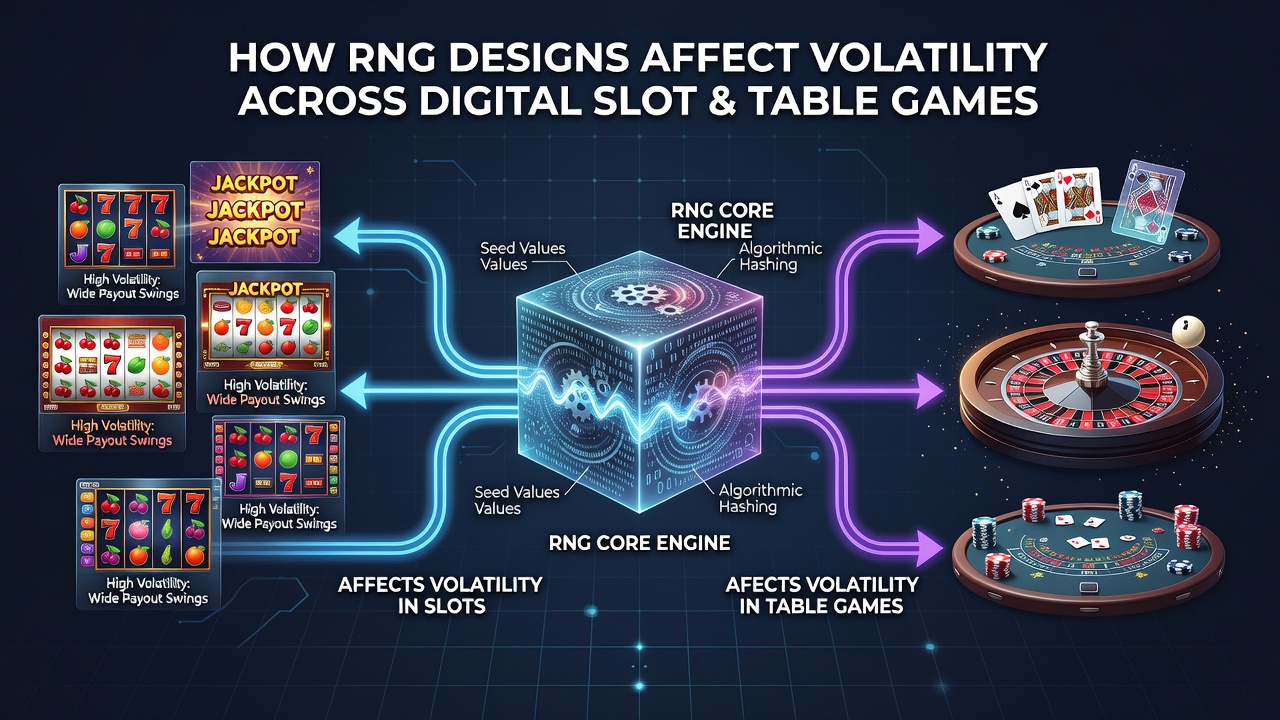
Table games apply similar principles yet operate under stricter structural constraints because card decks and dice follow fixed combinatorial rules. RNG implementations in blackjack or roulette must therefore randomize shuffles and spins while preserving exact mathematical probabilities, which limits the range of volatility designers can achieve compared with the more flexible reel-based systems in slots.
Comparative Effects Across Game Categories
Slot titles typically exhibit wider volatility ranges because developers enjoy greater freedom to adjust reel strips and bonus trigger rates through custom RNG weighting. Progressive jackpot slots often combine high volatility RNG layers with accumulating prize pools, resulting in sessions marked by extended dry spells followed by substantial payouts when the mapped outcome aligns. Fixed-payline games with simpler RNG distributions tend toward medium volatility profiles that balance frequency and magnitude more evenly.
Table game variants display narrower volatility bands overall because their RNG outputs must respect rigid probability structures. Digital roulette wheels, for instance, rely on RNG designs that produce uniform distributions across 37 or 38 pockets, so volatility remains relatively consistent regardless of minor algorithmic differences. Blackjack implementations introduce additional layers when they randomize multiple decks or shuffle points, yet the core combinatorial limits keep swings within tighter bounds than those observed in many slot products.
Regulatory Standards and Testing Protocols
Government bodies in multiple jurisdictions require independent verification that RNG designs meet statistical randomness thresholds before platforms receive operating licenses. The Alcohol and Gaming Commission of Ontario maintains detailed certification requirements that include long-sequence testing for period length and distribution uniformity. Similar frameworks exist in other regions, and data from these audits reveal that certified systems consistently pass chi-square and serial correlation tests across millions of simulated rounds.
Industry organizations such as the Gaming Laboratories International publish updated methodologies each year that labs must follow when evaluating new RNG submissions. These protocols measure not only basic randomness but also how specific design choices translate into observable volatility metrics during extended play simulations.
Developments Observed Through Mid-2026
By July 2026 several major platforms had adopted hybrid RNG approaches that combine software generators with periodic hardware entropy injections from certified devices. Early reports from testing agencies indicate these hybrids maintain the performance advantages of PRNGs while further reducing any theoretical predictability risks. Volatility profiles in newly released titles reflect these changes through slightly adjusted hit frequencies that remain within previously certified parameters.
Academic papers from engineering departments continue to examine how quantum-resistant RNG methods might eventually enter commercial gaming environments, though current deployments remain limited to research environments rather than live casino floors. Figures from regulatory submissions show no immediate shift in average volatility indices across the broader market despite these ongoing explorations.
Conclusion
RNG architecture choices exert measurable influence over volatility patterns in digital slots and table games through seed handling, algorithmic selection, and output mapping decisions. Regulatory testing ensures these systems meet statistical standards while allowing developers to calibrate game feel within defined boundaries. Continued monitoring by independent labs provides ongoing data on how evolving designs affect player experience across different game categories.