Craps Across Regions: Payout Structures and Rule Evolutions Through the Years
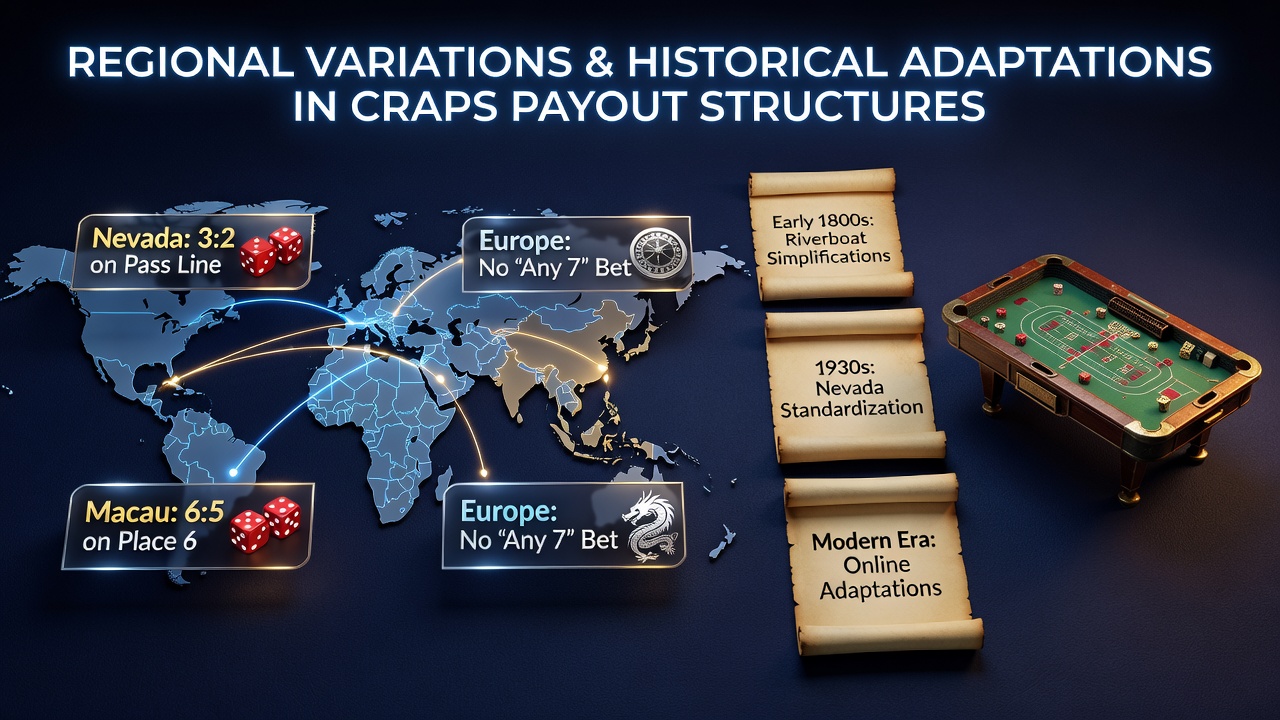
Regional differences in craps have developed over centuries as the game moved from its origins in Europe to widespread adoption in North America and beyond, with payout structures adapting to local regulations and player preferences while rule modifications addressed everything from dice handling to betting limits.
North American Payout Frameworks and Their Foundations
American casinos established core craps payouts that include even money returns on pass line bets alongside 2-to-1 odds on come bets when point numbers hit, yet variations emerged in states like Nevada where house edges sit at 1.36 percent on standard pass line wagers according to data compiled by the Nevada Gaming Control Board. Canadian provinces introduced similar structures but adjusted maximum odds bets to 10 times the original wager in many venues, which reduced the overall house advantage to under 0.5 percent in those configurations and reflected provincial gaming authority guidelines that prioritized player retention through competitive odds.
These frameworks trace back to early 20th century adaptations when illegal gambling operations in the United States standardized pass and don't pass bets to streamline enforcement, whereas later legalization in Atlantic City during the 1970s incorporated additional side bets like the fire bet that paid up to 999-to-1 in some New Jersey properties, a structure absent from most western state casinos at the time.
European and Asian Adaptations in Payout Mechanics
European versions of craps often feature payout adjustments that align with stricter regulatory oversight, such as those enforced by the Malta Gaming Authority where come and don't come bets maintain the same 2-to-1 returns but incorporate mandatory player cards that track cumulative wagers and trigger automatic limit resets after certain thresholds. In contrast, Asian markets including Macau casinos have modified craps layouts to emphasize higher volatility bets like the any seven proposition which pays 4-to-1 instead of the standard 4.5-to-1 seen elsewhere, a change introduced in the 2000s to match regional preferences for rapid resolution games and documented in industry reports from the University of Macau gaming research center.
Australian venues regulated under the Northern Territory government adopted hybrid rules that combine American pass line mechanics with European-style no craps on come-out rolls, resulting in payout tables that list 30-to-1 returns on hardway bets rather than the 29-to-1 common in U.S. markets, adjustments that emerged after 1990s legislative reviews aimed at harmonizing dice games with local poker variants.
Historical Rule Changes and Their Triggers
Rule adaptations began with the game's migration from 17th century hazard, where early English variants allowed only single dice rolls before evolving into multi-roll sequences that required new payout schedules to account for repeated point establishments. By the 1800s, riverboat gamblers in the United States introduced the don't pass bar on 12 rule to prevent ties from favoring the house excessively, a modification that spread through Mississippi river circuits and later influenced modern payout charts still used today.
The mid-1900s saw further shifts when Nevada regulators responded to organized crime concerns by mandating visible dice inspection protocols that indirectly affected betting timing and led to standardized horn bet payouts at 4-to-1 across the board. International expansions in the 1980s prompted additional tweaks, including the adoption of electronic dice verification systems in several jurisdictions which eliminated manual handling delays and allowed for faster proposition bet resolutions without altering core odds structures.

Contemporary Adjustments and Data Trends Into 2026
Recent regulatory updates continue to shape payouts, with a July 2026 report from the British Columbia Lottery Corporation highlighting how regional operators adjusted odds on big 6 and big 8 bets to 7-to-6 in select Canadian facilities to align with updated responsible gaming metrics that track session durations. Similar patterns appear in South African casino groups where the National Gambling Board data reveals incremental increases in field bet payouts from even money to 2-to-1 on 12 rolls as a direct response to player feedback collected through mandated surveys.
These ongoing modifications build on earlier precedents where rule sets expanded to include buy bets with commission structures varying from 4 percent in some U.S. tribal casinos to 5 percent in certain European properties, differences that research from the Alberta Gambling Research Institute attributes to varying tax frameworks applied to gaming revenues across borders.
Observers note that such regional experiments often lead to wider adoption when successful, as seen when the hop bet gained traction in multiple Asian markets after initial trials demonstrated its appeal without disrupting established pass line dynamics.
Conclusion
Regional payout variations in craps reflect layered responses to regulatory environments, historical migrations, and localized preferences that have refined the game across decades while preserving its fundamental dice mechanics. Data from multiple gaming authorities underscores how these adaptations maintain consistent house edges despite surface differences, ensuring the core structure remains intact amid evolving operational standards worldwide.